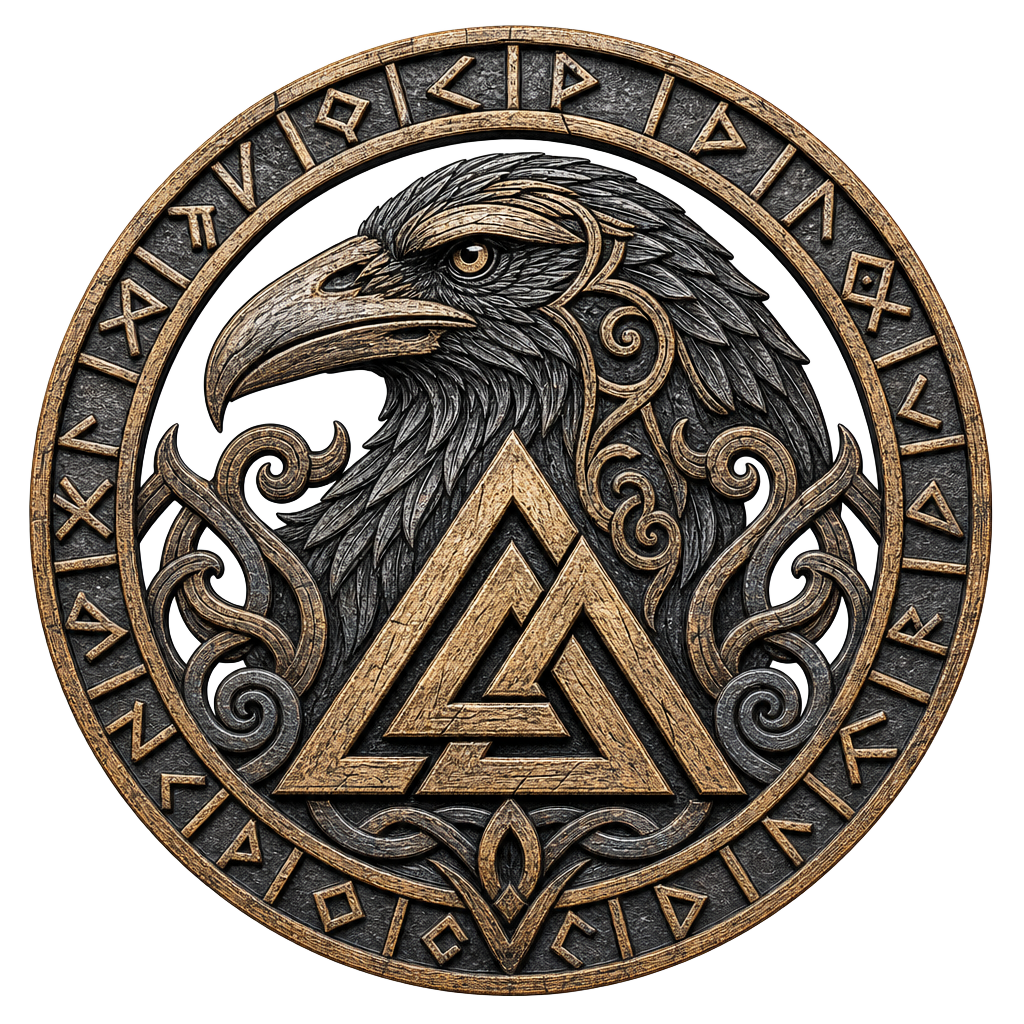
VIKINGS SYMBOLOGY
by Ph03niX
Browse all symbolsCover · page 23 of 33
69% read
An illuminated codex
Vikings
Symbology
by Ph03niX
Fourteen signs of the North — carved, worn, feared and inherited.
An illuminated codex
Vikings
Symbology
by Ph03niX
Fourteen signs of the North — carved, worn, feared and inherited.
An illuminated codex
Vikings
Symbology
by Ph03niX
Fourteen signs of the North — carved, worn, feared and inherited.
Foreword
Signs cut in stone
The Norse left few books. What they left instead were marks — on memorial stones raised at the edge of a field, on the prow of a ship, on a silver pendant no larger than a thumbnail, on the timbers of a burial chamber sealed under a mound of turf. Each mark was a compressed argument about the world: about fate, about death, about who owed what to whom.
This codex gathers fourteen of those signs. Some are genuinely of the Viking Age, dug from the ground and dated. Others — the Vegvísir, the Helm of Awe as drawn — come from the Icelandic grimoires of a later, colder, Christianised century, and are no less potent for it. Where the line falls between the two is noted honestly on every page.
Turn the leaf. Read what was carved, and what it was carved for.
Ph03niX
The Index
All the signs
Touch any sign to open its full study.
The Index
Continued
Touch any sign to open its full study.
Valknut
Valr + knut — “knot of the slain”
Three interlocking triangles bound in a single unbroken weave, carved beside scenes of death, sacrifice and Odin himself.
Read the full studyThe knot of the fallen warrior
Valknut
Nine points, three triangles, one continuous line: the number nine governs Norse cosmology — nine worlds on the branches of Yggdrasil, nine nights Odin hung on the tree, nine nights Freyr waited for Gerðr. The unicursal weave suggests that the fate of the warrior, the will of the god and the moment of death cannot be untangled from one another. Some scholars read it as the hugr, the bound mind, which Odin could loosen or fetter in battle to grant berserk fury or sudden paralysing fear.
Where it was used
Carved on memorial stones raised for men who died away from home, and on the funeral gear of the highest-status burials. Its placement is always funerary or sacrificial, never domestic — it is a mark set upon the dead, not a charm worn by the living.
“I know that I hung on a windy tree nine long nights, wounded with a spear, given to Odin, myself to myself.”
Hávamál, st. 138
Vegvísir
Vegvísir — “that which shows the way”
Eight ornate staves radiating from a centre, drawn so that the bearer may find the road home through weather they do not know.
Read the full studyThe wayfinder, the stave against being lost
Vegvísir
The Huld Manuscript gives the instruction plainly: “Beri maður stafi þessa á sér villist maður ekki í hríðum né vondu veðri, þótt ókunnugur sé” — carry this sign and you will not lose your way in storms or foul weather, even when the way is unknown to you. Each of the eight arms terminates in a different glyph, one for each of the eight cardinal directions, so that no quarter of the horizon is left unguarded.
Where it was used
Traditionally drawn in blood on the forehead, or inked on oak, and carried on the body when setting out on a journey through unfamiliar land or unpredictable sea.
“He who carries this sign with him will not lose his way in storms or bad weather.”
Huld Manuscript, 1860
Ægishjálmur
Ægishjálmr — “helm of awe”
Eight tridents thrust outward from a single point — a weapon of the mind, worn to break the courage of an enemy before the first blow lands.
Read the full studyThe terror worn between the eyes
Ægishjálmur
Ægishjálmur is not armour but dread made visible. The eight arms, each tipped with a trident and crossed with barred rungs, project outward in every direction — a field of fear surrounding the wearer. The Old Norse word ægir means both terror and the sea, so the name carries a double sense: the helm of the overwhelming, of that which cannot be resisted.
Where it was used
Pressed in lead onto the forehead between the brows before battle, or drawn on the inside of a helmet, so that the enemy would meet the sign before he met the man.
“The helm of awe I wore before the sons of men, in defence of my treasure.”
Fáfnismál, st. 16
Mjölnir
Mjǫllnir — “the grinder” or “lightning”
The short-hafted hammer forged by the dwarves Sindri and Brokkr — the single most commonly worn amulet of the Viking Age.
Read the full studyThor's hammer, the hallowing of what matters
Mjölnir
Mjölnir is the boundary weapon: it stands between the ordered world of gods and men and the giants of chaos beyond the fence. But it is not only destructive. Thor's hammer hallows — it blesses marriages, sanctifies boundaries, consecrates the newborn and the dead. In Þrymskviða the hammer is laid in the bride's lap to sanctify the wedding, and that is the moment Thor seizes it back.
Where it was used
Worn at the throat on a cord or chain, raised over the marriage bed, over the pyre, and over land claimed as one's own. Iron rings hung with tiny hammers were kept at temple doors as oath-rings.
“Bring the hammer to hallow the bride, lay Mjölnir on the maiden's knee.”
Þrymskviða, st. 30
Yggdrasil
Yggdrasill — “Odin's steed”
An immense ash whose branches arch over every world and whose three roots drink from three wells at the base of existence.
Read the full studyThe world tree that holds the nine realms
Yggdrasil
The name means Odin's horse — the gallows on which he hung himself for nine nights to seize the runes. The tree is therefore not scenery but the axis of sacrifice and knowledge. Its three roots reach Urðarbrunnr, where the Norns weave fate; Mímisbrunnr, the well of wisdom for which Odin gave an eye; and Hvergelmir, the roaring cauldron of Niflheim. It is constantly being eaten — by the dragon Níðhǫggr at the root, by four stags at the crown — and constantly healed by the Norns with white clay from the well.
Where it was used
Carved on chests, bedposts and portal beams; a household and dynastic sign of continuity and rooted lineage.
“An ash I know there stands, Yggdrasil is its name, a tall tree, showered with shining loam.”
Vǫluspá, st. 19
Web of Wyrd
Skuld's Net — the matrix of fate
A lattice of nine staves in which the shape of every rune of the Elder Futhark can be found — fate as a woven, not written, thing.
Read the full studyNine lines holding every rune ever cut
Web of Wyrd
Fate in Norse thought is not a script laid down in advance but a fabric under constant weaving. The three Norns — Urðr (what has become), Verðandi (what is becoming), Skuld (what shall be owed) — work at the loom, and every action pulls a thread that shifts the whole cloth. Because every rune can be traced within the nine lines, the web asserts that all possible outcomes are already latent in the weave; the choice is which line you pull.
Where it was used
Used as a meditative and divinatory frame — a field on which runes are cast or traced when seeking the shape of a situation.
“Laws they made there, and life allotted to the sons of men, and set their fates.”
Vǫluspá, st. 20
Triquetra
Þríhyrningr — the trinity knot
A three-lobed knot of interlaced vesicae, cut on Norse memorial stones and later absorbed wholesale into insular Christian art.
Read the full studyThree arcs, one unbroken line
Triquetra
Three is the structural number of Norse thought: three Norns, three roots of Yggdrasil, three sons of Borr, the triple death of sacrifice. The knot has no beginning and no terminus, so it renders eternity as a geometry. Read alongside a goddess it is often taken as maiden, mother, crone; read alongside the cosmos, as earth, sea and sky.
Where it was used
Carved on grave markers, doorframes and drinking horns; also worked into the borders of runestones as a protective closure of the inscription.
“Thence come the maidens, mighty in wisdom, three from the lake that stands beneath the tree.”
Vǫluspá, st. 20
Triple Horn of Odin
Þríhyrnd horn — the three draughts
Three interlocking drinking horns: Óðrœrir, Boðn and Són, the vessels holding the mead that makes a poet of whoever drinks it.
Read the full studyThe mead of poetry, stolen in three swallows
Triple Horn of Odin
Odin won the mead by boring through a mountain in serpent form, spending three nights with the giantess Gunnlǫð, and drinking all three vessels dry in three swallows before escaping as an eagle. The horns therefore signify inspiration bought at a price — the god of poetry is also the god who cheats, seduces and steals to get it. Poetry, in this reading, is never given; it is taken.
Where it was used
Cut on memorial stones for poets and law-speakers, and carved on the horns themselves, which were passed at the sumbel — the ritual round of toasts and oaths.
“Gunnlǫð gave me on a golden seat a drink of the precious mead.”
Hávamál, st. 105
Jörmungandr
Jǫrmungandr — “the vast monster”
The Midgard Serpent, thrown into the ocean by Odin, grown so large it encircles the earth and grips its own tail in its jaws.
Read the full studyThe serpent that circles the world and bites its tail
Jörmungandr
As an ouroboros the serpent is the boundary of the known world and the boundary of time itself: while it holds its tail, the world stands. When it lets go, Ragnarök begins. It is Thor's appointed enemy and his death — he will kill it and walk nine paces before the venom takes him. The serpent therefore encodes a hard Norse idea: the thing that defines you and the thing that ends you are the same thing.
Where it was used
Coiled into the borders of runestones and shield bosses, where its body becomes the frame containing the inscription — the world-serpent as literal boundary.
“Thor walks nine paces, then falls dead to the ground, poisoned by the serpent's venom.”
Gylfaginning, 51
Huginn & Muninn
Huginn ok Muninn — “thought and memory”
Odin's ravens, sent out at daybreak over all nine worlds, returning at meal-time to whisper what they have seen into his ears.
Read the full studyThe two ravens that fly the world each dawn
Huginn & Muninn
Huginn is thought; Muninn is memory. Odin sends both out and admits, in Grímnismál, that he fears for the return of thought but fears more for memory — the god of wisdom is afraid of forgetting. The pair render the two faculties on which all knowledge stands, and the corvid's carrion nature ties them to the battlefield: what the ravens see, they see over the dead.
Where it was used
Worked in pairs on brooches, helmet crests and standards; always mirrored, always facing one another or the figure between them.
“I fear for Huginn, that he come not back, yet more am I anxious for Muninn.”
Grímnismál, st. 20
Svefnþorn
Svefnþorn — “sleep thorn”
Four hooked staves used in the sagas to cast a sleep so deep the sleeper cannot be woken until the thorn is removed.
Read the full studyThe stave that lays a sleeper down for years
Svefnþorn
This is one of the few Norse signs whose function is unambiguously hostile — it removes a person from the world without killing them. Brynhildr sleeps ringed in fire until Sigurðr cuts the mail from her body. The thorn thus carries a double sense: enforced stillness as punishment, but also as preservation. What sleeps is not lost; it waits.
Where it was used
Carved on the head of a bed, on oak, or pressed under the pillow of the one to be put down. In the sagas it is placed by a god or a sorcerer, never casually.
“Odin stung her with the sleep-thorn, and said she should never again win victory in battle.”
Vǫlsunga saga, ch. 21
Gungnir
Gungnir — “the swaying one”
Odin's spear, forged by the sons of Ívaldi, carved with runes on its point, incapable of missing its mark or of stopping short.
Read the full studyThe spear that never misses and binds every oath
Gungnir
The spear is the instrument of oath and of dedication. Odin wounded himself with it on the world tree; he casts it to open the first war in the world; oaths sworn on its point cannot be broken. Where Mjölnir defends the enclosure, Gungnir declares intent — it is the weapon of the sovereign, the sworn word made iron.
Where it was used
A spear was thrown over an opposing army before battle with the cry “Óðinn á yðr alla” — Odin owns you all — giving the enemy dead to the god in advance.
“Odin hurled his spear and shot it over the host — that was the first war in the world.”
Vǫluspá, st. 24
Troll Cross
Trollkors — the bent iron
A simple odal-shaped loop of bent iron, hung at the threshold and worn at the belt to turn away trolls and malicious spirits.
Read the full studyA ring of iron against unfriendly things
Troll Cross
Its power lies in the material as much as the shape: cold iron was held throughout northern Europe to be intolerable to the hidden folk. The loop echoes the rune Óðal (ᛟ), the rune of inherited land, homestead and ancestral property — so the sign reads as a fence around what belongs to the family.
Where it was used
Hung over the door of house and barn, at the gate, and on the person when walking out after dark or crossing wild ground.
“Iron at the door, and nothing ill-meant crosses it.”
Swedish folk saying
Sleipnir
Sleipnir — “the slipper”
Odin's grey steed, born of Loki and the stallion Svaðilfari, able to run over sea and air and down into the realm of the dead.
Read the full studyThe eight-legged horse that rides between worlds
Sleipnir
Eight legs mean unmatched speed — but also the four men who carry a bier. Sleipnir carries Hermóðr down the road to Hel to bargain for Baldr's return and leaps the gate of the dead; he is the vehicle of passage between conditions. The horse belongs to a shamanic layer of Odin's character: the god who travels out of the body and comes back with news.
Where it was used
Depicted on memorial stones carrying a rider toward a welcoming figure with a horn — the arrival of the dead in the hall.
“Sleipnir is the best of horses; he is Odin's, and he has eight legs.”
Grímnismál, st. 44
“Cattle die, kinsmen die, and so must one die oneself. But the fair fame never dies of one who has earned it.”
Hávamál, st. 76Vikings Symbology — Ph03niX
Offline storage activates on the published site — install or open it there to keep pages.
Click a page edge or use ← → to turn
Bookmarks
No marks yet — use the Bookmark button on any page or symbol to keep your place.